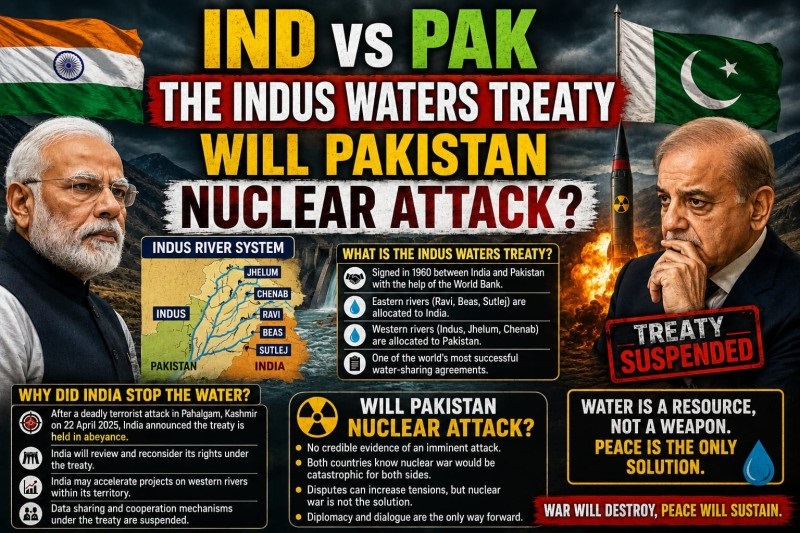
The India vs Pakistan Indus Waters Treaty, Pakistan’s Foreign Ministry threatened War and Will India block all of Pakistan’s water?. The Indus Waters Treaty between India and Pakistan was signed on September 19, 1960, under the mediation of the World Bank. India suspended this treaty in response to the Pahalgam attack (April, 2025).
Russia, the US, and China violated international treaties due to concerns regarding their national interests. Pakistan orchestrated the Mumbai attacks (2008), the Parliament attack (2001), the Pulwama attack (2009), the Mumbai bombings (1993), and the Pahalgam attack (2025) against India. Pakistan is a state that sponsors terrorism.
History of the Indus Waters Treaty
The Indus River is India’s oldest and largest river. This river originates from Sin-ka-Bab in Tibet. It originates in Kashmir, India, and flows into Pakistan. The length of the Indus River is 3,610 kilometers. Its five tributaries are the Vitasta, Chandrabhaga, Iravati, Vipasa, and Shatadru.
The Jhelum, Chenab, Vesh, and Sutlej are its major tributaries. This river is important for the agricultural land of both countries. Pakistan-backed terrorists enter India via this river. Pakistan orchestrated the Pahalgam attack on India in April 2025, prompting India to temporarily suspend the Indus Waters Treaty.
When was the Indus Waters Treaty signed?
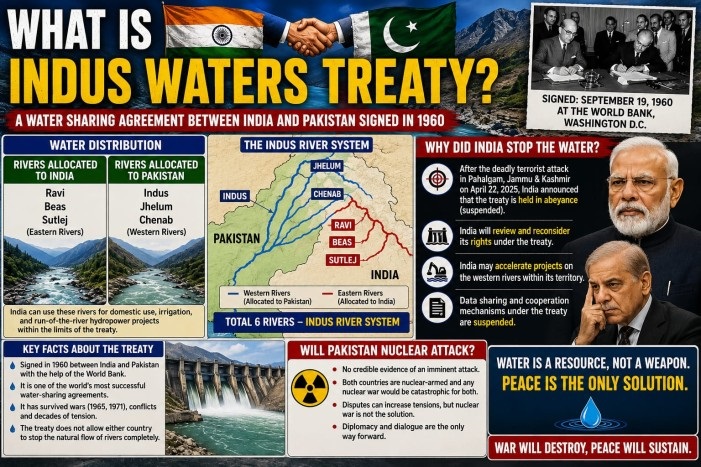
This was a significant agreement for both countries. On September 19, 1960, the World Bank brokered the Indus Waters Treaty between India and Pakistan in Karachi. This agreement was concluded under the leadership of Indian Prime Minister Pandit Jawaharlal Nehru and Pakistani Prime Minister Ayub Khan.
Under this agreement, India was allocated the waters of the eastern rivers—the Beas and the Sutlej. Pakistan received the western rivers, which included the Indus, Jhelum, and Chenab. As a result of this treaty, India received 20% of the water, while Pakistan received 80%.
What was the objective of the Indus Waters Treaty?
At the time of the country’s partition, the rivers were also divided. India is a vast country, with a multitude of rivers flowing across it. Water is essential for any nation’s population and agriculture. Before 1947, India lacked nothing; however, the British divided the country into fragments.
The Indus River flows through India before emptying into Pakistan. At the time of Partition, the river’s tributaries were divided: India was allocated 20% of the water from the eastern rivers, while Pakistan was allocated 80% of the water from the western rivers. Showing great magnanimity, India had provided significant assistance to Pakistan at the time of its independence.
Also READ : Iran War Disrupts Operations at Dubai Airport
Why is the Indus Waters Treaty necessary?
This is a very important question. At the time of the partition of India and Pakistan, the Indus River flowed through both countries. Both these countries depended on this river for agriculture and other activities. The tributaries of the Indus River flowed from India into Pakistan;
therefore, the division of all these rivers was clearly necessary. The primary objective regarding this river is to boost the agricultural sectors of both countries. After the partition of the country, the irrigated areas went to Pakistan. Therefore, the sharing of the Indus River’s water was crucial.
Can India abrogate the Indus Waters Treaty?
Many powerful countries across the world have broken treaties in the national interest. India is a country that respects all religions; however, there will be no compromise when it comes to India’s sovereignty. Pakistan has stabbed India in the back numerous times. Pakistan shelters major terrorists within the country.
India can present global arguments for breaking this treaty. If the US could withdraw from the JCPOA, Russia from the INF Treaty, and China reject the Hague ruling on the South China Sea, then India, too, could suspend the Indus Waters Treaty by citing national security. Pakistan will not desist from its antics.
Who benefits from the Indus Waters Treaty?
This is a very good question. Which country’s people benefit more from the Indus Waters Treaty? The whole world thinks that India gains more from it, but this is a misconception. Pakistan receives 80% of its water from the Indus River and uses it to make its plains fertile. This agreement was reached in the presence of the World Bank.
India is a liberal nation; it has always wished well for Pakistan. India receives 20% of its water from this river, yet Pakistan uses the river as a cover to infiltrate terrorists across the Indian border. Pakistan’s vast population depends on the waters of the Indus and the Jhelum. India is imposing a temporary ban on this.
What would happen if the Indus Waters Treaty were cancelled?
India does not want war with any country. India respects the sovereignty of its neighboring countries. 91% of Pakistan’s population depends on the Indus River. Pakistan’s agricultural sector will be severely affected. Blocking the water of this river will cause widespread distress and chaos in Pakistan.
This could lead to a war-like situation between the two countries. Pakistan is raising the issue of the Indus Waters Treaty on international platforms. Pakistan accuses India of violating this treaty. India has not violated this agreement so far; it has not stopped the flow of the Indus River’s water. However, there will be no talks until Pakistan stops harboring terrorists.
What is the current status of the Indus Waters Treaty?
In April 2025, terrorists shot 26 tourists in Pahalgam. Taking decisive action, India halted the flow of the Indus River’s water. India maintained that Pakistan was not desisting from its nefarious activities and was using terrorists against India. India suspended the 1960 treaty, citing terrorism.
Pakistan approached the Hague-based Permanent Court of Arbitration (PCA) and the United Nations Security Council (UNSC). However, no one came to Pakistan’s aid. India explicitly stated that this country spreads terrorism within its borders and, therefore, cannot be supported.
Where does the Indus River enter India?
This is a major river in Asia. It originates from Manasarovar Lake in the Tibet region of China and enters India through Ladakh. The river is of great importance to India. China is preparing to build dams to obstruct its flow, aiming to encircle India through this move. This river ends after flowing into Pakistan.
The length of this river is approximately 3,200 kilometers. This river makes the agricultural land fertile. The river is very useful for the agriculture of both India and Pakistan. Pakistan receives the majority of this river’s water. In view of Pakistan’s current activities, India has halted the flow of water from this river.
Also READ : US-Iran War Ceasefire Live Update