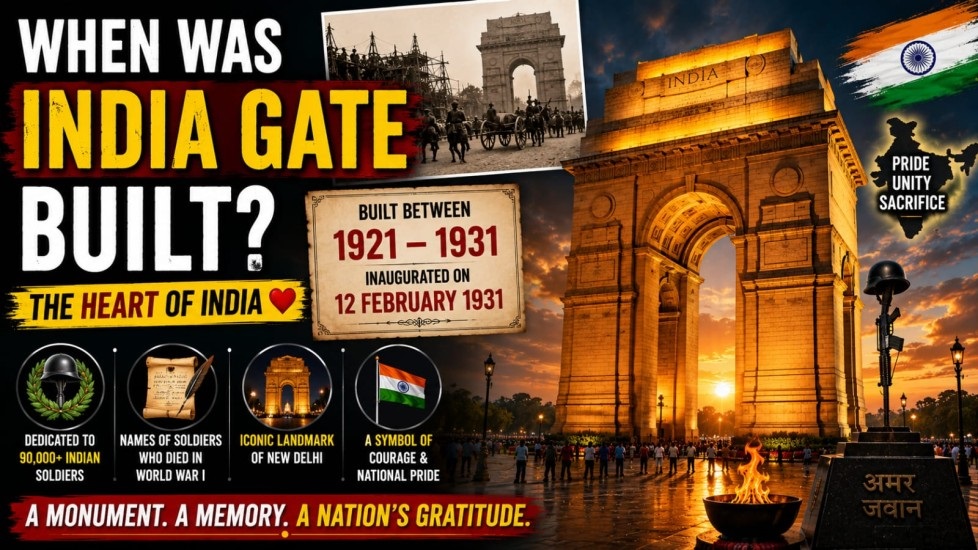
India Gate serves as a reminder of the glory of the valor of India’s soldiers. The British government built this in Delhi in memory of the 70,000 soldiers who were martyred in the First World War (1914-18). It is 82 meters Height and 9.1 meters width. A grand parade takes place on Republic Day at India Gate.
India Gate completed 100 years in 2021. The names of 13,542 British Indian soldiers are inscribed on its walls. On January 23, 2023, Prime Minister Narendra Modi unveiled a statue of Indian freedom fighter Subhash Chandra Bose at the India Gate complex on the occasion of his 125th birth anniversary.
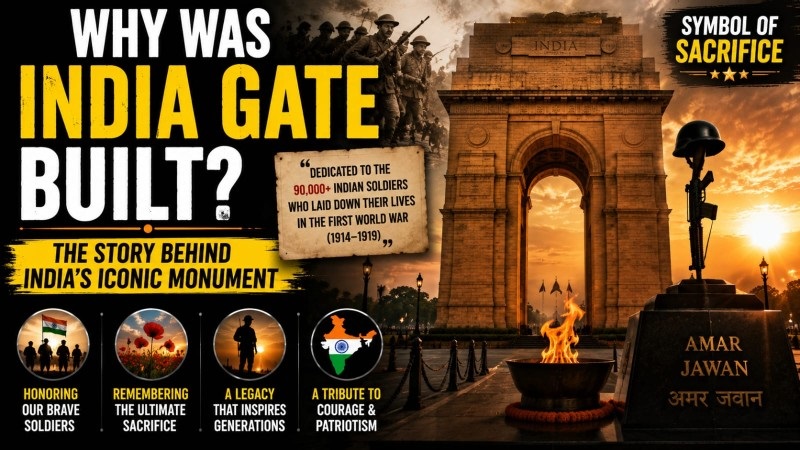
The History of India Gate
Prior to August 15, 1947, India was under British rule. The Indian Army served under the British administration. During the First World War, the British Indian Army participated in the conflict. Many soldiers were martyred in this war. Subsequently, numerous British Indian soldiers also laid down their lives during the Third Anglo-Afghan War (1919).
In memory of the Indian soldiers, the Duke laid the foundation stone of India Gate in Delhi on 12 February 1921. It took approximately ten arduous years to build. On February 12, 1931, the British Viceroy, Lord Irwin, inaugurated it. Edwin prepared the blueprint for this massive building.
Why was India Gate built in Delhi?
Sir Edwin Lutyens played a pivotal role in the creation of India Gate. In 1917, Edwin was appointed as the Chief Architect of the Imperial War Graves Commission. This commission oversaw the construction of memorials for soldiers who had fallen in battle. It carried out magnificent work across the entire world.
On December 12, 1911, the British monarch, King George V, announced the transfer of India’s capital from Calcutta to Delhi. The British government made Delhi the capital. All British Viceroys operated from Delhi. Construction work in Delhi is progressing at a good pace.
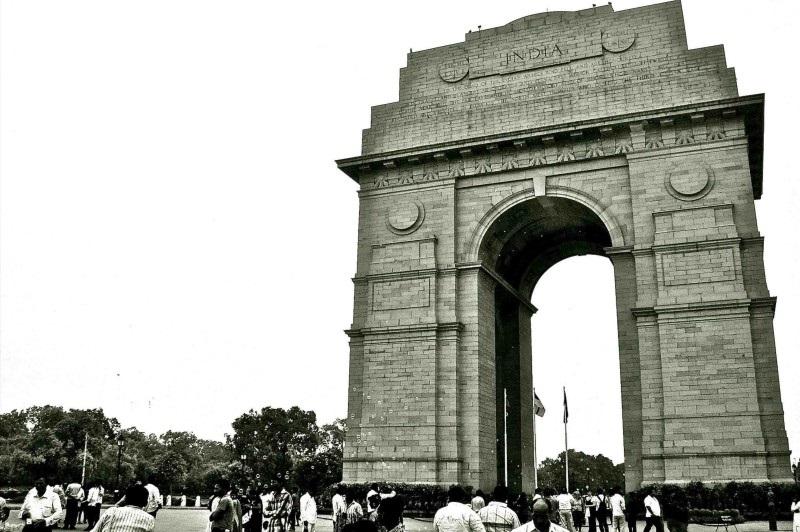
What is written on India Gate?
Inscribed on the left side of its arch is MCMXIV (1914), and on the right side, MCMXIX (1919). Above the arch sits a shallow, domed bowl, designed to hold a flame on commemorative occasions. It is situated within a hexagonal area with a diameter of 625 meters and spans a total area of 306,000 square meters.
India Gate glows with the illumination from the surrounding fountains. At night, the lighting on India Gate creates an image of the Indian tricolor flag.
Also READ : US-Iran War Ceasefire Live Update
When was the Canopy Made?
It is located in Delhi. The British government idolized the British king. The British ruled India for 200 years. Lakhs of people in the country go to see it every day. In 1930, Raja Jagatjit Singh of the princely state of Punjab appealed to all the princely states to install the statue of George Pancham at India Gate. It is 150 meters away from India Gate.
I went to see this with my friends. It is very beautiful. Indian revolutionaries drove the British out of India. In the struggle for independence, Babasaheb Ambedkar made his greatest contribution by securing rights for the Dalits and the backward classes. They ruled India for 200 years.
Who prevented the installation of King George V’s statue?
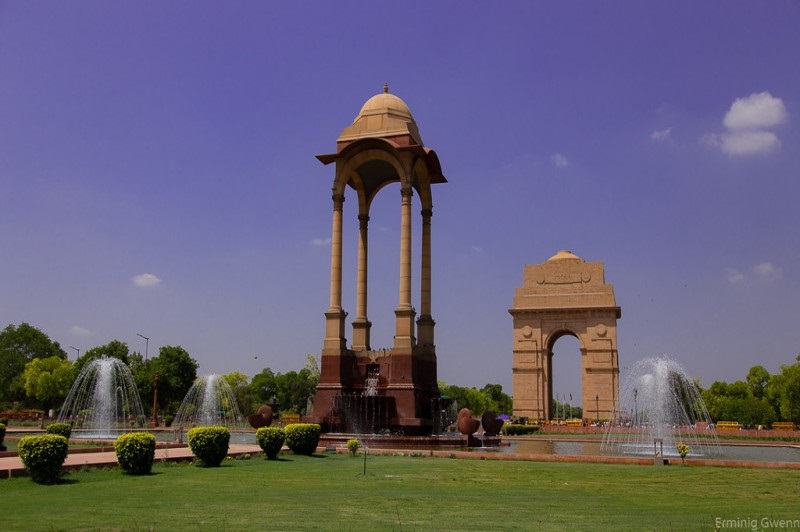
The statue of Emperor George V of British India faced significant opposition in India. The Indian princes had this statue installed at India Gate. The height of its pedestal is (34.5 feet) and the height of its canopy is (10.52 meters). The height of the statue of George Samrath is 18.75 feet.
On January 3, 1943, Hemvati Nandan Bahuguna and Manubhai Shah climbed up the statue and broke its nose. The canopy that once housed the statue of George V now holds the statue of Netaji Subhas Chandra Bose. The statue of Netaji Subhas Chandra Bose is 28 feet tall and 6 feet wide. It is a 3D holographic statue.
Where is the Amar Jawan Jyoti?
This monument is located at India Gate. Indian soldiers live in our hearts. You can visit it to see it. A war took place between India and Pakistan in 1971. Indian people cherish the memory of martyrs.. You can come to see this with your family.
On Republic Day, Vijay Diwas (Victory Day), and Infantry Day, the Prime Minister and the Chiefs of the Armed Forces lay wreaths at the Amar Jawan Jyoti. The Indian Army provides security for this monument. You can go to India Gate to see this. It is very secure from a security perspective.
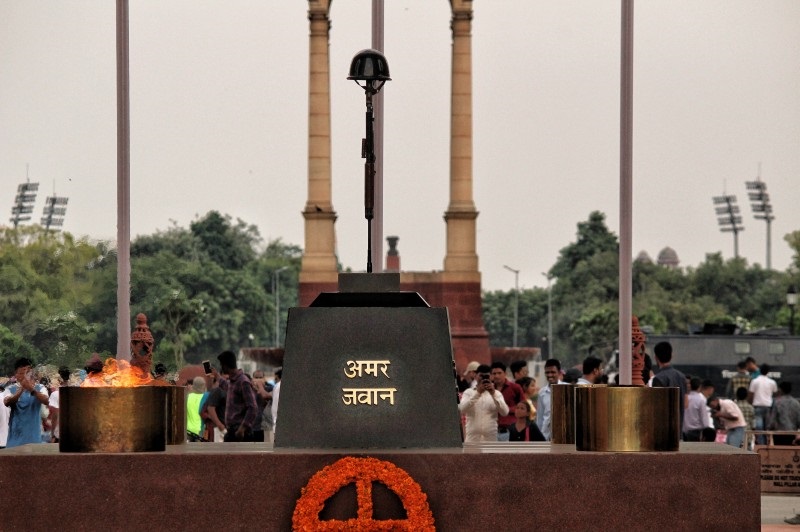
The Amar Jawan Jyoti Memorial Facts
The Amar Jawan Jyoti Memorial is very beautiful. You can see it with your family. This monument features images depicting the wars involving China and Pakistan. It is beautifully Manuments. Upon seeing this, a sense of reverence for soldiers will awaken within you.
The Amar Jawan Jyoti memorial is located at two places. Indra Gandhi inaugurated it on January 26, 1972. The Prime Minister of the country, Narendra Modi, inaugurated it on January 25, 2019. The soldiers of the country made a huge contribution to India.
Why does a flame burn at the Amar Jawan Jyoti?
A rectangular platform stands at the center of the Amar Jawan Jyoti Memorial. Its platform serves as a reminder of bravery.. Mounted atop it is an L1A1 self-loading rifle, with an unknown soldier’s helmet resting upon its barrel. In this memorial, a flame serves as a reminder of the martyrs.
Today, millions of people from India and abroad visit India Gate. India Gate is a symbol of India’s honor and pride. All of us Indians are proud that our soldiers laid down their lives for the country.
Where is the Republic Day parade held?
The Republic Day Parade takes place at India Gate. This parade begins at Rashtrapati Bhavan. Grand events are organized at India Gate on 26 January. People come to this venue to watch this parade. It is a truly beautiful sight. You must come with your family to watch the parade on January 26, 2027.
A parade takes place on Kartavya Path. The nation’s soldiers showcase their duties. Everyone cheers to boost their morale. Many great personalities have been born in India. Babasaheb, Bhagat Singh, and Mahatma Gandhi made a significant contribution to the country’s independence.
Aslo READ : CSK vs DC 18th IPL 2026 War